
AC102 and Tinnitus: A Drug That May Repair the Damage Behind the Ringing
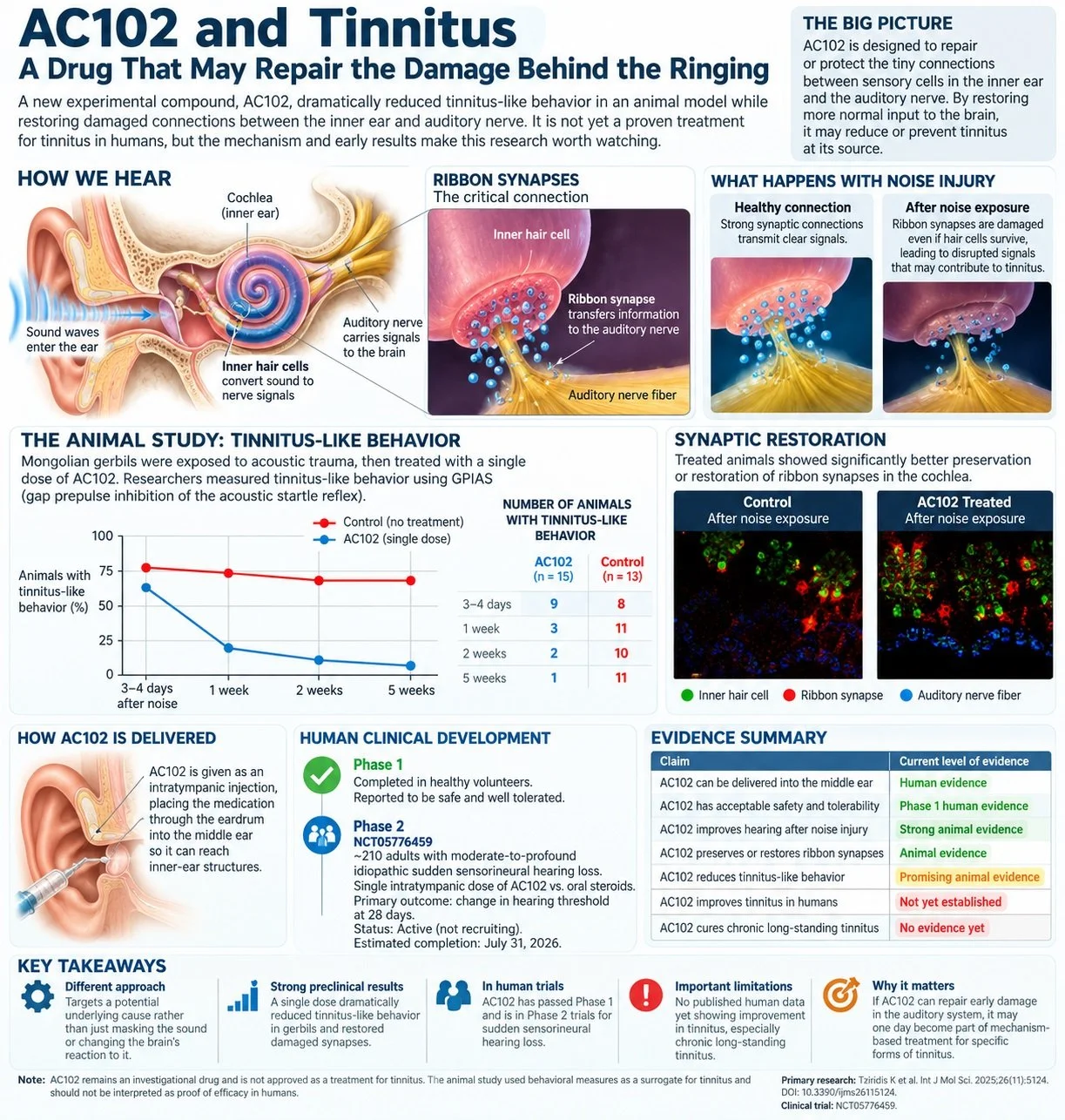
A new experimental compound called AC102 almost eliminated tinnitus-like behavior in an animal model while restoring damaged connections between the inner ear and auditory nerve. It is still much too early to call this a tinnitus cure, especially for people living with chronic tinnitus, but the mechanism behind it is different enough, and the early results are strong enough, that this is research worth paying attention to.
If you live with tinnitus, you probably know the routine by now. Every few months another headline floats across the internet promising that scientists may have finally figured out how to stop the ringing, buzzing, whistling, humming, screaming, or whatever particular noise your brain has decided to manufacture for you. Some of those stories involve supplements, some involve sound therapy, some involve electrical stimulation, some involve devices designed to retrain the brain, and some are little more than recycled hope wrapped in a new headline. So when I saw a story claiming that a new compound called AC102 made constant ear noise disappear in an animal model, my first reaction was interest followed almost immediately by skepticism.
The more I read, though, the more interesting it became, because AC102 is not simply another attempt to cover up tinnitus, distract the brain from it, or teach someone to cope better with the sound. The researchers appear to be targeting a piece of the physical damage that may contribute to tinnitus in the first place, specifically the tiny connections between sensory cells inside the cochlea and the auditory nerve. In an animal study published in 2025, researchers exposed Mongolian gerbils to acoustic trauma, waited for tinnitus-like behavior to develop, and then treated them with a single dose of AC102 delivered through the eardrum into the middle ear.
Five weeks later, the difference between the treated and untreated animals was hard to ignore.
Only 1 of 15 animals treated with AC102 still showed behavioral evidence consistent with tinnitus, while 11 of 13 untreated control animals continued to show it. Just as importantly, the researchers found evidence that the drug had restored some of the damaged connections between inner-ear sensory cells and the auditory nerve. In other words, the animals did not simply behave differently after receiving a drug. Researchers could also see measurable structural improvement inside the auditory system itself.
That is the part that got my attention.
Tinnitus May Begin With a Broken Connection
To understand why this matters, it helps to understand just how much has to go right for us to hear normally. Deep inside the cochlea are specialized sensory cells called inner hair cells. These cells respond to sound and communicate with fibers of the auditory nerve through microscopic structures known as ribbon synapses. You can think of those synapses as tiny transfer points where information from the ear is handed off to the nerve on its way toward the brain.
Noise exposure can damage these connections even when the hair cells themselves survive and even when a standard hearing test does not look disastrous. This kind of injury is often discussed under the term cochlear synaptopathy, and it is sometimes described more casually as part of “hidden hearing loss,” because someone can technically hear tones in a quiet test booth while still having disrupted communication between the ear and brain.
Researchers have increasingly wondered whether this kind of degraded signal might help explain tinnitus. If the brain suddenly receives incomplete, distorted, or weakened information from the ear, it may try to compensate by increasing neural gain or changing activity within auditory pathways. Over time, those changes may produce abnormal spontaneous firing patterns or persistent sound perception even when there is no external sound present.
That would mean tinnitus is not necessarily the original injury. It may be the brain's response to missing or distorted input.
That distinction is enormous, because if the problem begins upstream with damage to the ear-to-nerve connection, then one possible treatment strategy is not simply to teach the brain to ignore the tinnitus. It is to repair the damaged connection that may be helping drive it.
That is essentially where AC102 enters the picture.
What the Researchers Actually Found
The AC102 tinnitus study was conducted by researchers from University Hospital Erlangen in Germany together with scientists associated with AudioCure Pharma, the company developing the compound, and it was published in the International Journal of Molecular Sciences in May 2025.
Researchers exposed Mongolian gerbils to acoustic trauma that produced relatively modest hearing-threshold changes rather than catastrophic deafness. The animals subsequently developed behavioral changes interpreted as tinnitus, and several days after the noise exposure they were divided into treated and control groups.
At that early point, the groups looked very similar. Nine of fifteen animals in the AC102 group showed tinnitus-like behavior, compared with eight of thirteen in the control group. That is important because it means the treated animals were not somehow starting out healthier.
What happened afterward is where the study becomes interesting.
One week after treatment, only 3 of 15 AC102-treated animals still showed tinnitus-like behavior, compared with 11 of 13 controls. After two weeks, it had fallen to 2 of 15 treated animals, while 10 of 13 controls continued to show the behavior. By five weeks, only 1 of 15 AC102-treated animals still met the behavioral criteria for tinnitus, while 11 of 13 untreated animals remained affected.
At the same time, examination of the cochlea showed that animals treated with AC102 had significantly better preservation or restoration of ribbon synapses.
The tinnitus-like behavior improved while the physical connections inside the auditory system improved with it.
That does not prove that one directly caused the other, but it gives researchers something far more substantial than simply saying, “the animal acted better after the drug.”
But Did the Gerbils Really Have Tinnitus?
This is where a little caution is needed, because an animal cannot tell us what it hears. A gerbil cannot sit down after the experiment and say, “the high-pitched tone in my left ear disappeared last Thursday.” Researchers therefore have to infer tinnitus from behavior.
The method used in this study is called gap prepulse inhibition of the acoustic startle reflex, usually abbreviated GPIAS. The basic idea is that an animal hears background noise containing a very brief silent gap immediately before a startling sound. If the animal detects the gap, its response to the startling sound changes. Researchers theorize that tinnitus may perceptually fill in that gap, making it harder for the animal to detect.
GPIAS has been used extensively in tinnitus research, but it is still an indirect measurement, and there is scientific debate about how perfectly it maps onto the subjective experience of tinnitus in humans.
So when a headline says that AC102 “made tinnitus disappear,” the more scientifically accurate description is that AC102 caused tinnitus-like behavioral responses in this particular animal model to fall dramatically over several weeks.
That is less dramatic than the headline, but it is still a remarkable result.
Where the Evidence Actually Stands
This is probably the simplest way to look at AC102 right now:
ClaimCurrent level of evidenceAC102 can be delivered locally into the middle earHuman evidenceAC102 has shown acceptable early safety and tolerabilityPhase 1 human evidenceAC102 improves hearing after noise-related injuryStrong preclinical animal evidenceAC102 can preserve or restore cochlear ribbon synapsesPreclinical animal evidenceAC102 dramatically reduces tinnitus-like behavior after acoustic traumaPromising animal evidenceAC102 improves tinnitus in humansNot yet establishedAC102 cures chronic long-standing tinnitusNo evidence yet
That table is where I think the excitement and the caution can coexist.
The preclinical results are strong enough to take seriously, but the human tinnitus question is still open.
AC102 Is Already Being Tested in Humans
One reason this research is especially interesting is that AC102 is not sitting in a laboratory waiting for someone to decide whether it is worth trying in people. The compound has already moved into human clinical development.
A Phase 1 study in healthy volunteers evaluated the drug's safety and tolerability, and AudioCure reported that the treatment was well tolerated. AC102 is delivered through an intratympanic injection, meaning the medication is placed through the eardrum into the middle ear so that it can reach structures of the inner ear.
A larger Phase 2 study, identified as NCT05776459, enrolled approximately 210 adults with moderate-to-profound idiopathic sudden sensorineural hearing loss. Participants received either a single intratympanic dose of AC102 or oral steroid treatment, which is commonly used in sudden hearing loss.
The important point is that this human trial is primarily evaluating hearing recovery, not chronic tinnitus.
That distinction is easy to miss when you read a headline about tinnitus.
AC102 has been given to humans.
AC102 has progressed into Phase 2 clinical trials.
But AC102 has not yet been shown in published human data to eliminate tinnitus.
That is where we are right now.
Acute Tinnitus and Chronic Tinnitus May Be Very Different Problems
This may be the biggest limitation when thinking about what AC102 could eventually mean for people who have lived with tinnitus for years.
The animals in this study were treated shortly after acoustic injury. The human development program has also focused heavily on sudden sensorineural hearing loss and acute inner-ear injury. In those situations, there may be a relatively short window during which damaged synapses can still be protected, repaired, or regenerated before longer-term changes in the nervous system become established.
Chronic tinnitus may be much more complicated.
Once tinnitus has persisted for months or years, changes may no longer be limited to the cochlea. The auditory nerve, brainstem, thalamus, auditory cortex, attention networks, emotional circuits, and other parts of the brain can all become involved. The nervous system adapts, compensates, and sometimes appears to incorporate the tinnitus signal into its normal operating pattern.
At that point, repairing the original injury inside the ear might still help.
It might help tremendously in some people.
Or it might do very little because the tinnitus has effectively become a central nervous system phenomenon.
Nobody knows yet.
This is also why talking about “tinnitus” as though it is one single disease may ultimately be a mistake. Someone whose tinnitus began after years of occupational noise exposure may have a different underlying mechanism from someone whose tinnitus began after a traumatic brain injury, blast exposure, medication reaction, infection, sudden hearing loss, jaw dysfunction, age-related hearing loss, or central auditory injury.
The eventual future of tinnitus treatment may not be one cure.
It may be identifying the mechanism behind a person's tinnitus and treating that mechanism specifically.
AC102 could eventually become part of that kind of approach.
Why This Research Feels Different
Most current tinnitus management focuses, understandably, on reducing suffering. Sound therapy can help. Hearing aids can help. Cognitive behavioral therapy can help. Neuromodulation is increasingly being explored. For some people, these approaches make an enormous difference in quality of life.
But many of them are primarily focused on reducing the perception of tinnitus or changing the brain's reaction to it.
AC102 is interesting because it raises the possibility of doing something further upstream.
The theoretical chain may look something like this:
Noise or inner-ear injury → ribbon-synapse damage → degraded auditory-nerve signaling → abnormal compensation within the auditory system → tinnitus
AC102 potentially introduces another path:
AC102 → preservation or restoration of synaptic connections → improved auditory-nerve signaling → less abnormal input driving tinnitus
That pathway is still hypothetical in humans, but the animal research supports enough pieces of it that it deserves serious attention.
Rather than simply asking, “How do we make this sound less annoying?” researchers may be asking a much more fundamental question:
What if we can repair the injury that helped create the sound in the first place?
That is a different conversation.
There Is Also a Conflict-of-Interest Issue Worth Knowing About
AudioCure Pharma is developing AC102, and several authors of the tinnitus study are affiliated with the company. AudioCure has also promoted the results publicly.
That does not make the research invalid. Drug companies necessarily participate in the development and testing of their own compounds, and industry-funded research is a normal part of pharmaceutical development.
But it is still important context.
The strongest confirmation would come from successful randomized human trials, peer-reviewed publication of those results, independent replication, and eventually larger studies showing that the effect holds up across different populations and different forms of tinnitus.
We are not there yet.
So Is AC102 a Tinnitus Cure?
No.
At least not based on what we currently know.
What we have is an experimental drug that appears capable of restoring or protecting important connections inside the inner ear in animal models, has shown substantial hearing recovery in preclinical research, and has dramatically reduced tinnitus-like behavior after acoustic trauma in gerbils.
We also know that AC102 has passed early human safety testing and moved into Phase 2 human trials for sudden sensorineural hearing loss.
What we do not yet have is published evidence showing that AC102 makes tinnitus disappear in people, especially people who have lived with chronic tinnitus for years.
That distinction matters, because false hope does not help anybody.
But neither does dismissing promising research simply because it has not reached the finish line yet.
Why I Think This One Is Worth Watching
I have become skeptical of tinnitus headlines because there have been so many of them, but AC102 survived a deeper look for me because the story is not simply about turning down a perceived sound. The researchers found behavioral improvement alongside measurable restoration of physical structures involved in carrying sound information from the cochlea to the auditory nerve.
For anyone interested in tinnitus, auditory processing, traumatic brain injury, hidden hearing loss, or the strange borderland where the ear ends and the brain begins, that is fascinating.
We often talk about tinnitus as though the noise itself is the disease, but perhaps in some people the noise is actually the nervous system's response to a damaged signal somewhere upstream.
If that is true, then repairing the signal could eventually become more important than masking the sound.
AC102 is nowhere near proving that yet in humans, but the possibility is legitimate enough that I think it deserves both optimism and restraint.
For now, the fairest way to describe the research is this:
The gerbil results are remarkable. The biology is compelling. The human tinnitus evidence is still missing.
And the human results are the ones that ultimately matter.
Research note: AC102 remains an investigational drug and is not approved as a treatment for tinnitus. The tinnitus study discussed here used behavioral measures in animals as a surrogate for tinnitus and should not be interpreted as proof of efficacy in humans.
Primary research: Tziridis K, Rasheed J, Kwiatkowska M, Wright M, Schlingensiepen R. A Single Dose of AC102 Reverts Tinnitus by Restoring Ribbon Synapses in Noise-Exposed Mongolian Gerbils. International Journal of Molecular Sciences. 2025;26(11):5124. DOI: 10.3390/ijms26115124.
Clinical trial: NCT05776459 — Phase II study evaluating AC102 versus oral corticosteroid treatment in idiopathic sudden sensorineural hearing loss.